
1956 THEN AND NOW
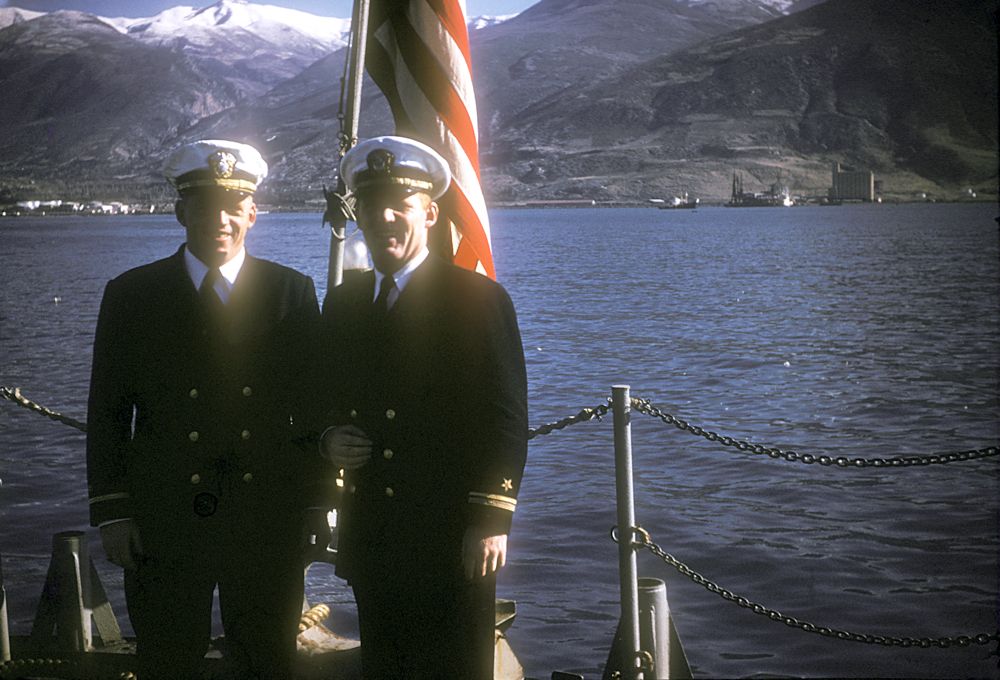
The time was November 1956. I was OOD on the mid-watch, 12am to 4am, aboard the USS Abbot. The ship was my responsibility. I was officer of the deck. The Captain was asleep in his sea cabin just aft of the bridge.
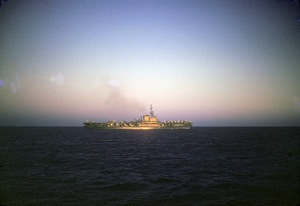
Our radar had been tracking a contact that was overtaking us on a parallel course to port and was now about a mile away. Our orders were to challenge all contacts by light, asking them to identify themselves and give their destination. The night was cloudy with the wind occasionally gusting to 20 knots. Shafts of silvery light from the half-moon pierced the clouds, periodically illuminating the outline of a large ship. As the distance closed, we recognized the silhouette of an aircraft carrier. Repeated attempts by the quartermaster to raise the carrier by light failed. She was traveling at “darken ship.”
I was nervous at our inability to get a response. I finally barked at the lookout, “Cogan, better get the Skipper out here on the double!”
We were in the Eastern Mediterranean. We had sailed from Newport, R.I. on Election Day 11/6/1956. The date was no coincidence! Eisenhower was elected in a landslide. The campaign was dominated by two major international crises. In Europe, Hungary was in a revolt against Communism and Soviet domination and, in the Middle East, Israel had invaded Egypt in response to the July nationalization of the Suez Canal.
Today, a lack of operational intelligence, a deplorable state of military readiness and a lack of a coherent U.S. strategy appear to accompany the current upheaval in the Arab world. Back then, however, the leadership of our country sent a strong message to friends and foes alike – the U.S. was ready to take on any task that came our way.
When Britain and France followed Israel with a series of large-scale air raids on Egypt on October 31st, Eisenhower spoke out tactfully against the attacks by three of our closest allies.
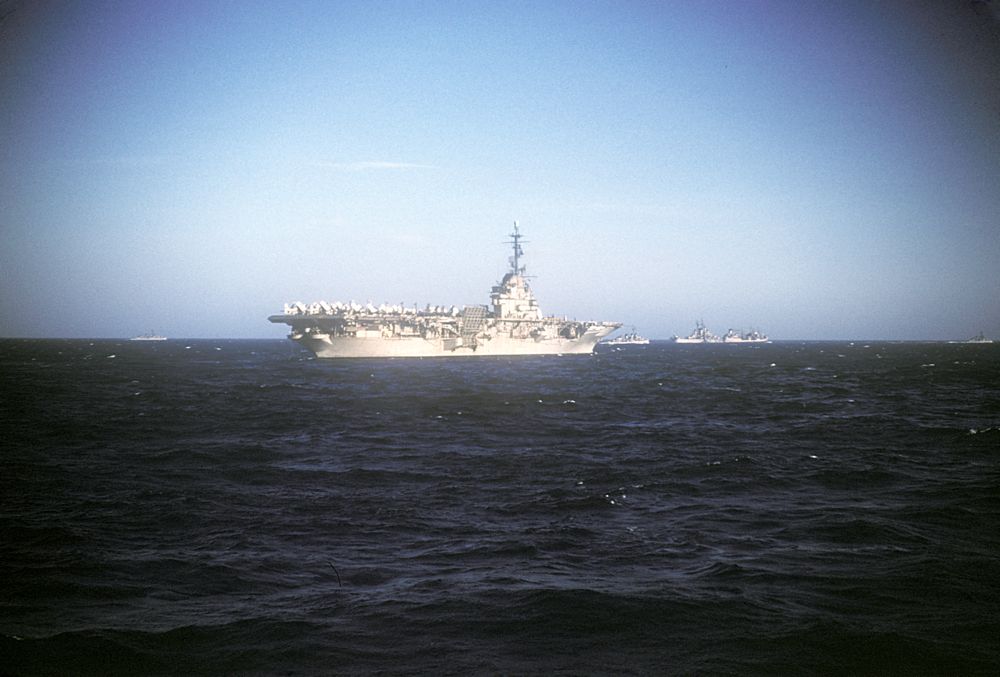
Unlike today, back then the U.S. deployed powerful elements of the 6th Fleet – the carriers USS Coral Sea and USS Randolph – with their escorts to the waters southwest of Crete and conducted evacuations during the heaviest fighting of the conflict from October 31st through November 2nd. The U.S. armed forces rescued more than 4,500 non-combatants.[i]
On October 31st, Chief Of Naval Operations Admiral Arleigh Burke placed the 6th Fleet on alert and signaled 6th Fleet Commander Admiral “Cat” Brown: “Situation tense; prepare for imminent hostilities.” Admiral Brown signaled back: “Am prepared for imminent hostilities, but whose side are we on?” In classic Burke style, the CNO responded, “Keep clear of foreign op areas, but take no guff from anybody.”[ii]
Tensions elevated. The afternoon of November 5th, the Soviets sent diplomatic notes to Britain, France and Israel threatening to take military action to crush the aggressors and restore peace in the Middle East. President Eisenhower’s reaction, “If those fellows start something, we may have to hit ‘em – and, if necessary, with everything in the bucket.”[iii]
Coral Sea and Randolph with their escorts moved to the area southwest of Crete to better position themselves for a general emergency, should it occur. Britain and France ended their military operations at midnight, November 6th, the day we sailed from Newport with eleven other destroyers. On November 7th, CNO Burke ordered carriers Forestall and Roosevelt to sail from Norfolk, along with a heavy cruiser and three divisions – a total of twelve destroyers – and head for the Azores, to act as standby forces to the 6th Fleet and execute emergency war plans if necessary.[iv]
Back on the Abbot, we were patrolling in the Eastern Med with our sister ship the Hale, oblivious to the massive resources readying in the western Med and on the way from the U.S., along with the diplomatic maneuvering that was taking place behind the scenes.
All of a sudden, the Captain appeared rushing through the open shell door leading from the bridge to the port wing where we were trying to raise the darkened carrier by light. He was dressed only in his skivvies and shower sandals and a T-shirt. I briefed him quickly.
In addition to the fixed signal light, we had a back-up – a hand-held, trigger-operated light that the Captain grabbed. He began to signal the carrier, identifying himself as the operator. That did the trick. The response was almost instant. The quartermaster began to record the responses on a clipboard. Our contact was the British Carrier HMS Eagle on the way to Alexandria to evacuate British Nationals.
Once the identification was complete, our Captain wished the Brits good luck. They thanked us and added, “Wish you were coming with us Yanks!” Our Captain replied, “If I had my way, we would be.” The Captain stayed with us until the carrier was almost out of sight still in his skivvies and then returned to his cabin.
Observing the tepid, tentative, at times confusing response that we have mounted to the events currently taking place in the Middle East makes me yearn for the days when peace was earned through strength and timely response. Mr. President, where were our carriers when Egypt erupted? Where are they now? Why did it take so long to get just one carrier into the Med? Why didn’t anyone see this coming? What does it say about us when we have to charter a ferry to evacuate our nationals? Where are the grown-ups? I pray for the future of my country!
George S.K. Rider
 Red Rider's Ramblings: Rants, reminiscences and repartee from a 93+ year-old rookie writer
George
This story reminds me of a somewhat similar one that happened in the spring of 1958.
At the time I was the executive officer of the Marine Detachment on a carrier, the USS Hornet (CVA 12) operating someplace in the general vicinity of Indonesia. We had been pulled out of a scheduled liberty stop in Hong Kong on very short notice — some of the crew had to chase us down in private boats as we sailed out of the harbor — and sent to a ‘secret’ staion some place in the Pacific Ocean.
Once we arrived there (I never did figure out where we were) we Marines were told to get ready to go ashore and bring out the Americans civilians there. We test fired our weapons off the fantail, while the sailors looked on in astonishment. We pretended it was just business as usualfor us, although I was shaking in my combat boots.
Then we noticed the most amazing thing: the airplane crews were painting over all identifying marks on the planes, including painting over the prominent markings on the wing and fuselage. We were getting ready to attack someone, some place, but we didn’t want to admit it was us doing it.
We all waited for the order to do our thing, but it never came. We packed up our weapons and sailed back to Hong Kong to finish our business ashore.
I have always wondered where we were and who we were getting ready to go up against.
These days I would hate to see us get into yet another war (two are enough, thank you) so I hope the folks in charge don’t do anything foolish just to show we have the capability to do so. In fact I have become such a wimp that I’d take a billion out of the Marine Corps budget to keep PBS/NPR, the Peace Corps, and the National Endowments for the Arts and the Humanities fully funded.